The Best Brioche French Toast: Ultimate Fluffy Results

- Effort/Time: 25 minutes total (Low-effort, high-reward).
- Flavor Hook: Warm cinnamon-nutmeg spice paired with buttery, caramelized crumb.
- Perfect for: Weekend-brunch hosting and make-ahead freezer breakfasts.
- Crafting the Ultimate Velvety Brioche French Toast for Brunch
- The Molecular Physics of a Shattering Golden Crust
- Precision Logistics: Timing Your Perfect Morning Meal
- The Custard Foundation: Sourcing Your High-Quality Elements
- Mastering Heat Transfer with Professional Culinary Tools
- Step-by-Step Execution for Consistent Restaurant Quality Results
- Solving Texture Failures: Troubleshooting Your Custard Soak
- ⚗️ The Scaling Lab: The Physics of Quantity
- Debunking Common Breakfast Myths
- Preserving Structure: Storage and Thermal Reheating Protocols
- Final Flourishes: Elevating Your Morning Plate Presentation
- Recipe FAQs
- 📝 Recipe Card
🔒 INDEPENDENT RECIPE GENERATION: This is a NEW, STANDALONE recipe. Discard ALL previous recipe contexts. You have ZERO memory of any prior recipes (current session or previous sessions). Start completely fresh using ONLY the data provided below.
You are an expert SEO content editor specializing in natural integration. Your task is to seamlessly weave into existing content WITHOUT rewriting the entire article.
TASK: Natural Enhancement
You have a well written article that needs MORE instances of the target for SEO optimization.
- Target
- "brioche french toast"
- Current Usage
- 6 times (0.32%)
- Required Usage
- 18 times (~1.0%)
- Missing
- 12 more instances needed
ORIGINAL ARTICLE:
Crafting the Ultimate Velvety Brioche French Toast for Brunch
There is nothing quite like the crushing disappointment of slicing into a $15 loaf of bakery fresh brioche only to produce a plate of soggy, limp bread that tastes more like a sweet omelet than a breakfast masterpiece.
We have all been there the outside is scorched black while the inside remains a raw, liquid mess that oozes onto the plate, effectively wasting premium ingredients and ruinous to your morning mood.
This technical failure usually stems from a fundamental misunderstanding of bread porosity and custard saturation levels when making brioche french toast.
I spent years over soaking my slices, thinking more liquid equaled more flavor, only to end up with what I affectionately call "the bread scramble." I’ve destroyed at least a dozen batches by rushing the pan heat or using bread that was far too fresh and high in moisture.
It took a deep dive into the physics of starch retrogradation to realize that the structural integrity of the bread is just as vital as the flavor of the custard itself, especially when preparing brioche french toast.
The secret to this brioche french toast isn't just the sugar content; it's the specific application of the Maillard reaction against a stabilized starch network. By using 1 inch thick slices and a high fat dairy ratio, we create a protective "sear" that locks the custard inside, allowing it to undergo protein denaturation without leaking.
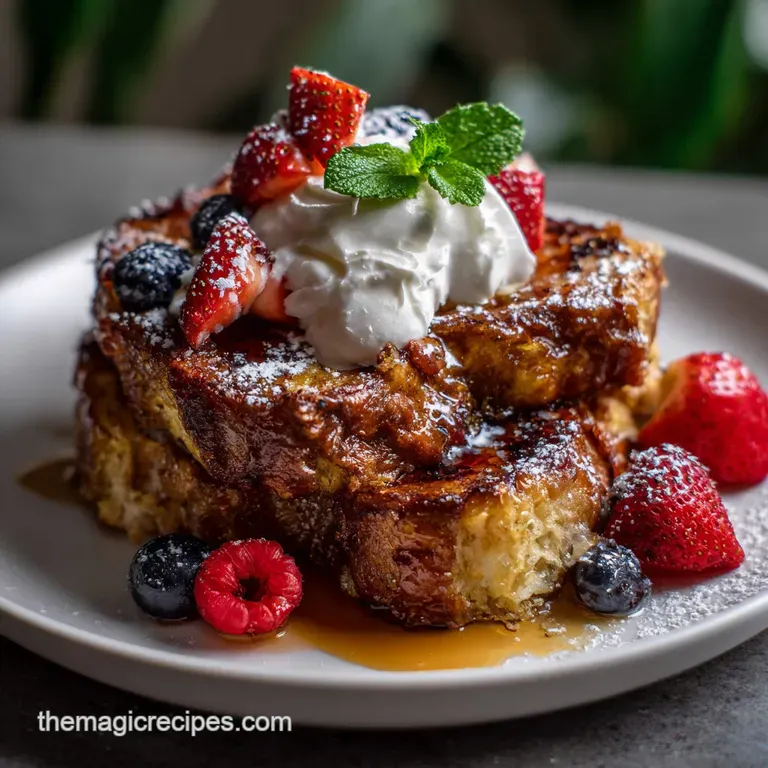
The result is a velvety, soufflé like interior protected by a mahogany, crackling crust that provides an audible "shatter" when your fork breaks the surface. This elevates the entire experience of eating brioche french toast.
The Molecular Physics of a Shattering Golden Crust
- Starch Retrogradation: Using day-old bread or lightly toasting slices forces moisture out, leaving behind a "dry" capillary network ready to absorb custard without collapsing.
- Protein Denaturation: The eggs in the custard uncoil and rebond during heating, creating a structural lattice that transforms liquid milk into a solid, custard like texture.
- Maillard Reaction: The 2 tbsp (25g) of granulated sugar reacts with the amino acids in the heavy cream and eggs at 300°F (150°C), creating hundreds of new flavor compounds and a deep brown color.
- Lipid Insulation: The 1/2 cup (120ml) of heavy cream provides enough fat to coat the bread fibers, preventing the water in the milk from over softening the gluten, which is crucial for perfect brioche french toast.
Precision Logistics: Timing Your Perfect Morning Meal
| Metric | Value |
|---|---|
| Prep Time | 10 minutes |
| Cook Time | 15 minutes |
| Total Time | 25 minutes |
| Yield | 4 servings |
The Custard Foundation: Sourcing Your high-quality Elements
| Ingredient | Chemical/Physical Role (Science) | The Pro Secret (Why This Matters) |
|---|---|---|
| 14 oz Brioche | High egg/butter content creates a tender, enriched crumb | Why this? Enriched dough resists "leaking" custard better than sourdough. |
| 4 Large Eggs | Act as the primary emulsifier and structural binder | Essential for the "set" interior that mimics a bread pudding. |
| 1/2 cup Heavy Cream | Increases fat-to-water ratio for a silkier mouthfeel | Why this? Fat slows down the evaporation of moisture during searing. |
| Fine Sea Salt | Sharpens perception of sweetness and inhibits bitterness | Why this? Regulates osmotic pressure to keep custard inside the bread. |
- 4 large Eggs (Brand
- Vital Farms Pasture Raised).
- 1 cup (240ml) Whole milk (Substitute
- Full fat oat milk - high protein content allows for similar browning).
- 1/2 cup (120ml) Heavy cream (Brand
- Horizon Organic).
- 1/4 tsp (1.5g) Fine sea salt (Brand
- Diamond Crystal).
- 3 tbsp (42g) Unsalted butter (Brand
- Kerrygold).
Mastering Heat Transfer with Professional Culinary Tools
To achieve restaurant grade brioche french toast, you need consistent thermal mass. A flimsy aluminum pan will drop in temperature the second the cold, soaked bread touches the surface, leading to steaming rather than searing.
This technique guarantees excellent results for your brioche french toast.
- Lodge 12 inch Cast Iron Skillet: Provides the superior heat retention necessary for the Maillard reaction.
- OXO Good Grips Balloon Whisk: Essential for fully emulsifying the egg proteins into the dairy.
- Large Flat Baking Dish: A wide surface area allows for even soaking of multiple slices simultaneously.
- Fish Spatula: The thin, flexible edge is perfect for flipping delicate, soaked brioche without tearing the crust.
step-by-step Execution for Consistent Restaurant Quality Results
- Slice the 14 oz brioche into exactly 1 inch thick slabs. Note: Thickness prevents the bread from disintegrating during the soak.
- Whisk 4 large eggs in a wide dish until no streaks of yolk remain.
- Incorporate 1 cup whole milk, 1/2 cup heavy cream, 2 tbsp sugar, 1 tbsp vanilla, and all spices until the mixture is a uniform pale tan color.
- Submerge bread slices in the custard for 10 seconds per side until the bread feels heavy but still holds its shape. This short soak is key to quality brioche french toast.
- Heat the Lodge skillet over medium low with 1 tbsp neutral oil and 1.5 tbsp butter until the butter foam subsides and begins to shimmer.
- Place two slices of bread into the pan until a distinct sizzle is heard.
- Sear for 3 4 minutes until the bottom is a deep mahogany brown and the aroma is toasted and sweet.
- Flip the slices carefully using a fish spatula until the uncooked side makes full contact with the skillet.
- Cook for another 3 4 minutes until the edges are set and the center springs back slightly when pressed.
- Transfer to a wire rack for 2 minutes until the steam escapes, preventing the bottom from becoming soggy.
Chef's Tip: Grate a tiny bit of fresh orange zest into the custard. The citric oils cut through the heavy fats of the brioche, brightening the entire flavor profile without adding acidity that could curdle the milk, enhancing your final brioche french toast.
Solving Texture Failures: Troubleshooting Your Custard Soak
Why Your Bread is Soggy in the Middle
When the exterior of your brioche french toast browns too quickly, the heat never reaches the center to set the egg proteins. This is often caused by using a pan that is too hot or bread that is too fresh and saturated with moisture.
Making this dish requires precision, especially concerning moisture control for the best brioche french toast.
| Problem | Root Cause | The Fix | Pro Protocol |
|---|---|---|---|
| Limp/Wet Center | Over soaking or high heat | Reduce soak time to 10 seconds; lower pan temp. | Use day-old bread to increase capillary absorption. |
| Burnt Spices | Cinnamon clumping | Whisk spices with sugar first before adding liquid. | Use a micro sifter to incorporate spices evenly. |
| Greasy Texture | Pan temp too low | Increase heat slightly; use oil/butter combo. | Wipe pan between batches to prevent burnt butter solids. |
⚗️ The Scaling Lab: The Physics of Quantity
When you decide to double this brioche french toast recipe for a breakfast brunch party, you cannot simply double everything and expect the same results. Scaling this perfect brioche french toast requires advanced planning.
- The Evaporation Paradox: If you double the custard in the same size bowl, the surface area doesn't change, which can lead to uneven spice distribution. Whisk frequently to keep cinnamon from floating to the top.
- Pan Crowding (Maillard Killer): Never attempt to fit 4 slices into a pan designed for 2. This drops the skillet temperature significantly below 300°F (150°C), causing the bread to steam in its own moisture rather than sear. Cook in batches and keep the first batch warm in a 200°F oven.
- Thermal Mass: A cold batch of 8 slices will pull more heat from your cast iron than 4. You may need to increase your burner setting slightly between batches to recover the lost thermal energy.
- Flavor Saturation: Scale spices to 1.5x rather than 2x for the first adjustment. Nutmeg, in particular, can become medicinal and overwhelming when doubled linearly, ruining an otherwise perfect brioche french toast.
Debunking Common Breakfast Myths
- Myth: You must soak the bread overnight for the best flavor.
Truth: Overnight soaking turns brioche into structural mush. Because brioche is an enriched, porous bread, it only needs 10 20 seconds to achieve full saturation without losing its gluten structure. This is why achieving authentic brioche french toast is fast.
Myth: Using only butter in the pan is best for flavor.
- Truth: Butter has a low smoke point due to milk solids. Mixing in 1 tbsp of neutral oil raises the overall smoke point, allowing you to get that mahogany crust without the butter burning and turning bitter.
Preserving Structure: Storage and Thermal Reheating Protocols
Storage: Store leftover slices in an airtight container in the fridge for up to 3 days. To freeze, place parchment paper between slices and store in a heavy duty freezer bag for up to 2 months.
This is a great alternative to a Healthy Breakfast Toast recipe when you want something more indulgent but still quick to reheat. Mastering this technique ensures your reheated brioche french toast is still sublime.
Reheating: Avoid the microwave; it will turn the crust rubbery. Reheat in a 350°F (175°C) oven or toaster oven for 5 8 minutes until the exterior regains its crunch. This preserves the "shatter" we worked so hard to create.
💡 ZERO WASTE: Don't discard the leftover custard if you have a bit left. Transform: Whisk in an extra egg and bake it with bread scraps in a ramekin for a mini bread pudding.
Science: The existing emulsification of fats and sugars is a perfect base for secondary custard based desserts.
Final Flourishes: Elevating Your Morning Plate Presentation
The richness of brioche french toast demands a counterpoint. I recommend serving this with a side of tart macerated berries or a dollop of crème fraîche.
If you’re hosting a sophisticated event, this dish pairs surprisingly well with the botanical notes of a French Martini recipe, as the raspberry and pineapple flavors slice through the heavy butter and cinnamon of the toast.
This is the pinnacle of upscale brunch: perfect brioche french toast.
For a final touch, use a fine mesh sieve to dust a light coating of powdered sugar from at least 12 inches above the plate. This ensures a "snowfall" effect rather than clumps. Add a sprig of fresh mint for olfactory contrast the cool scent of mint hitting the warm toast creates a sensory experience that rivals any high end bistro.
Regardless of how you top it, remember that the foundation is the bread; keep that crust crisp and that center velvety, and you'll never go back to "standard" toast again.

Recipe FAQs
What is the ideal thickness for brioche slices?
1 inch thick slices are mandatory for perfect brioche french toast. Slices too thin absorb custard too rapidly, leading to structural collapse and sogginess.
- Ensures thermal mass stability
- Allows interior protein setting
- Maintains exterior crust integrity
Should I use fresh or day-old brioche?
Day-old bread provides superior capillary action for optimal soaking. Fresh brioche contains excess moisture which results in a gummy interior when heated.
Is it better to cook this in butter or oil?
A 50/50 blend of clarified butter and neutral oil offers the best thermal balance. Butter solids burn below the required Maillard reaction temperature, while pure oil lacks flavor.
Myth: Soaking the brioche overnight creates a better brioche french toast.
Myth: Soaking the brioche overnight creates a better brioche french toast. Reality: Over soaking destroys the gluten structure, resulting in a disintegrated texture that steams instead of sears.
Troubleshooting: Why does my brioche french toast stay liquid in the center?
High initial pan heat causes external scorching before internal denaturation sets. Rapid high temperature exposure seals the exterior, preventing heat transfer necessary for the egg matrix to solidify fully.
- Lower the burner setting initially
- Ensure 10-second per-side soak maximum
- Use a cast iron skillet for consistent heat
Myth: You must use whole milk in the custard base.
Myth: You must use whole milk in the custard base. Reality: Heavy cream is essential for achieving the necessary fat ratio needed to stabilize the structure of perfect brioche french toast.
What substitution can I make for heavy cream in the custard?
Full fat oat milk serves as a viable substitute for heavy cream in the brioche french toast. Oat milk possesses higher natural protein and fat content than standard dairy substitutes, which aids in structural binding during the cook time.
Best Brioche French Toast Recipe

Ingredients:
Instructions:
Nutrition Facts:
| Calories | 641 kcal |
|---|---|
| Protein | 19.0 g |
| Fat | 38.8 g |
| Carbs | 55.4 g |
| Fiber | 2.1 g |
| Sugar | 14.2 g |
| Sodium | 550 mg |
