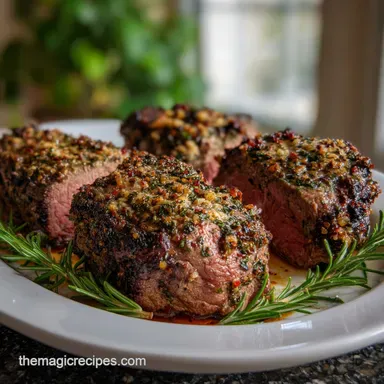
Garlic Herb Beef Tenderloin with Garlic Butter

- Total1 Hrs 45 Mins
- Calories300 kcal
- CuisineAmerican
- Time: 20 min active + 30 min cooking + 55 min resting
- Skill level: Moderate. The steps are short, but the sear and the doneness check decide the result.
- Great for: Holiday dinners or a special Sunday meal for 8. Too slow for a quick weeknight.
What Makes the Crust Work
- Room-Temperature Start: Sitting out for 30 to 45 mins takes the chill off the center. The outside doesn't overcook while the middle catches up.
- Dry Surface, Hot Pan: Browning needs a dry surface and high heat. Water on the outside steams the meat, so patting it dry first is what lets the skillet brown it.
- Butter After the Sear: Spreading the butter with the pan off the heat lets it melt onto the crust. It doesn't scorch in the skillet before the roast goes into the oven.
The Building Blocks
Most of the flavor comes from the herb butter, so that's where substitutions matter most. Four ingredients do the heavy lifting here.
| Component | Purpose | Substitute Notes |
|---|---|---|
| Unsalted butter | Carries the garlic and herbs onto the crust as it melts | Salted butter works. Skip the ¼ tsp salt, then taste the butter before spreading. |
| Olive oil | Carries heat into the pan for the sear | Avocado oil handles the heat well. Olive oil adds a fruitier note to the crust. |
| Fresh rosemary and thyme | Herb flavor that holds through roasting | Dried works but is stronger. Start with about 1 tsp dried rosemary and 1 tsp dried thyme. |
| Kosher salt | Seasons the beef and the butter | Table salt is saltier by volume. Start with less, then taste the butter. |
Those swaps are the budget route. Dried herbs and salted butter cost less and still carry the flavor, and the beef itself stays the same. Swaps change flavor, not the method, so the sear and the oven time stay put.
- 2 lb (900 g) center-cut beef tenderloin, trimmed and tied with kitchen twine Why this? Center-cut has an even thickness, so it cooks more evenly than the thin tail.
- 1 tsp (6 g) kosher salt, for the beef
- 1 tsp (2 g) freshly ground black pepper
- 1 tbsp (15 ml) olive oil
- ½ cup (115 g) unsalted butter, softened to room temperature Why this? Softened butter mashes smoothly with the herbs and spreads evenly.
- 4 cloves garlic, finely minced (about 12 g)
- 1 tbsp fresh rosemary, finely chopped (about 3 g)
- 1 tbsp fresh thyme leaves (about 4 g)
- 1 tbsp fresh flat-leaf parsley, finely chopped (about 4 g)
- 1 tsp lemon zest (about 2 g)
- ¼ tsp (1.5 g) kosher salt, for the butter
Numbers That Decide Doneness
- Oven: 425°F (220°C). Preheat it while the skillet heats so the roast goes in right after the sear.
- Sear: 8 to 10 mins total, rolling the roast so all six sides brown.
- Rest and slice: 10 mins under loose foil, then 1-inch (2.5 cm) rounds for 8 servings.
Cooking the Roast, Stage by Stage
Stage 1: Season and tie
Pat the tenderloin completely dry with paper towels. Rub it all over with 1 tsp (6 g) kosher salt and the black pepper, then let it sit at room temperature for 30 to 45 mins. Tie the roast with kitchen twine at 1½- to 2-inch (4 to 5 cm) intervals.
Tuck the thin tail end under itself so the roast is an even thickness from end to end.
Chef's note: Wet beef steams in the pan instead of browning, so don't skip the paper towels.

Stage 2: Mix the butter
In a small bowl, mash the softened butter with the garlic, rosemary, thyme, parsley, lemon zest, and ¼ tsp (1.5 g) kosher salt until the mixture is uniformly green-flecked and spreadable. Set it aside while the pan heats.
Tip: Mince the garlic fine. Larger pieces scorch in the oven before the center reaches temperature.
Stage 3: Preheat the pan
Preheat a 12-inch cast iron or other heavy oven-safe skillet over medium-high heat for about 3 mins. Preheat the oven to 425°F (220°C) at the same time.
Stage 4: Sear all sides
Add the olive oil and wait until it shimmers. Place the tenderloin in the skillet and sear, rolling to brown all four long sides and both ends. Expect 8 to 10 mins total until the crust is chestnut brown with no pale spots.

Stage 5: Butter and roast
Remove the skillet from the heat. Spread the garlic-herb butter over the top and sides of the hot roast. The butter melts and sizzles on contact. Transfer the skillet to the oven and roast 18 to 22 mins, checking the temperature starting at 16 mins.
Stage 6: Check doneness
Insert an instant-read thermometer into the thickest part of the center. Pull the roast at 125°F (52°C) for medium-rare. Carryover heat lifts the center to 130 to 135°F (54 to 57°C) during the rest.
For fully cooked beef, pull at 145°F (63°C) instead, the safe internal temperature listed on FoodSafety.gov.
Stage 7: Rest and slice
Move the roast to a cutting board, tent it loosely with foil, and rest for 10 mins so the juices settle. Snip off the twine and slice 1-inch (2.5 cm) thick rounds for 8 servings. Spoon the buttery pan juices over the slices.
Tip: Snip the twine after resting. Cutting around it while the roast is hot is fiddly.

Make-ahead and Leftover Tips
The herb butter can be prepared in advance. Roll it into a log using plastic wrap and store it in the fridge, allowing it to soften for 15 to 20 mins before spreading. Because it contains garlic, this butter must be refrigerated rather than left on the counter.
Storing Cooked Slices
Once cooled, slices will last 3 to 4 days in an airtight container in the refrigerator, according to USDA leftovers guidance. Do not let cut slices sit out for more than 2 hours, or only 1 hour if the room temperature is above 90°F (32°C).
Reheating and Freezing Slices
Wrap each slice tightly in plastic wrap before sealing them in a freezer bag. Slices stored this way keep their texture for several months. Thaw them in the refrigerator overnight. To reheat, place slices on a baking sheet in a 250°F (120°C) oven.
Use a thermometer to ensure the thickest slice reaches 165°F (74°C). Avoid the microwave, as it tends to dry out the edges and soften the crust.
Your Questions, Answered

Will the salt in the herb butter mellow while the roast cooks?
No, salt doesn't cook off, so the butter tastes just as salty after roasting. The recipe uses only 1/4 tsp kosher salt for the whole roast, so the butter is already mild, and the pan juices are where saltiness concentrates. If they taste too salty, spoon them sparingly or stir them into brown gravy.
Can I roast at 350°F instead to share oven space?
Stick with 425°F (220°C), because the 8 to 10 minute sear and 18 to 22 minute roast are timed for that heat. A lower oven gives a paler crust, and this recipe doesn't give times for it.
If oven space is tight, roast at 425°F and pull the beef at 125°F (52°C) for medium-rare, checking the thickest part with an instant-read thermometer.
How much dried herbs should I use instead of fresh?
Use the fresh herbs as written: 1 tbsp each of finely chopped rosemary, thyme leaves, and flat-leaf parsley. This recipe doesn't give a dried conversion, and dried herbs are more concentrated, so use noticeably less than the fresh measure rather than matching it.
How long do leftover slices keep, and how should I store them?
Cooled slices keep 3 to 4 days in a sealed container in the refrigerator. Don't leave cut slices out more than 2 hours at room temperature, or 1 hour if the room is above 90°F (32°C).
What internal temperature should the beef reach before resting?
Pull the roast at 125°F (52°C) for medium-rare, and carryover heat will bring the center to 130 to 135°F (54 to 57°C) during the 10 minute rest. For fully cooked beef, pull it at 145°F (63°C) instead.
Garlic Herb Beef Tenderloin with Garlic Butter
Ingredients:
Instructions:
Try These Next

5-Ingredient Beef Enchilada with Red Sauce
Whip up easy beef enchiladas with red sauce in just 30 minutes!

Easy Chimichurri Sauce Recipe: Bright Herb Sauce
Master this easy chimichurri sauce recipe with our step-by-step guide.

Sourdough Pizza Grilled Cheese Sandwich
Use a lid to trap heat while grilling this Pizza Grilled Cheese Sandwich.

How to Make Brown Gravy: Rich, Savory Sauce
Learn how to make brown gravy from scratch with this easy, quick recipe.
